|
Arming
Sword
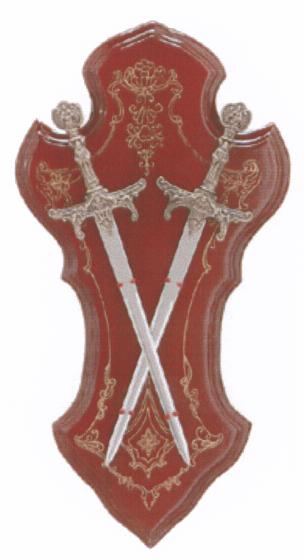
- after the 14th century, with the appearance
of the longsword the simple, single-handed weapon became known
as a short sword or arming sword, since it hung from the belt
of the knight, while his longsword hung from the saddle. In
the mid-15th century treatise How a Man Shayl be Armyd, the
author advises: “hys shorte swerde upon hys lyfte syde
in a rounde ryunge all nakid to pulle out lightlie....and
then hys long swerd in hys hand.’
 Backsword
- The backsword was so named because it only had one cutting
edge. The non-cutting edge (the back of the blade) was much
thicker than the cutting edge thus creating a wedge type shape
which was said to increase the weapons cutting capacity. Also
known as a "Mortuary Sword", or the German "Reitschwert."
Backsword
- The backsword was so named because it only had one cutting
edge. The non-cutting edge (the back of the blade) was much
thicker than the cutting edge thus creating a wedge type shape
which was said to increase the weapons cutting capacity. Also
known as a "Mortuary Sword", or the German "Reitschwert."
Basilard
- a two-edged, long bladed dagger of the late Middle Ages,
often worn with both civilian dress and armour.
Bastard
Swords
- developed in the mid 1400's as a form of
long-sword with specially shaped grips for one or two hands.
These swords typically had longer handles which allowed use
by one or both hands. The sword's hilt often had side-rings
and finger rings to defend the hand, and a more slender, or
tapered, narrowly pointed blade. Bastard swords continued
to be used by knights and men-at-arms into the 1500's, and
for a time, enjoyed the civilian side-arm role that would
later be superceded by the sidesword and rapier.
Broadsword
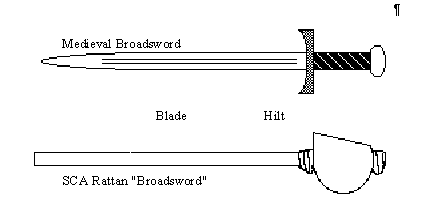
- A term popularly misapplied as a generic synonym for medieval
swords. The now popular misnomer "broadsword" as
a term for medieval blades actually originated with Victorian
collectors in the early 19th century.
 The
term " broadsword" seems to have originated in the
17th century, referring to a double-edged military sword,
with a complex hilt. A medieval sword was simply called a
"sword," a "short sword" (in the works
of George Silver), or an "arming sword."
The
term " broadsword" seems to have originated in the
17th century, referring to a double-edged military sword,
with a complex hilt. A medieval sword was simply called a
"sword," a "short sword" (in the works
of George Silver), or an "arming sword."
Further complicating the issue is a "true broadsword,"
which is actually an 18th century short naval cutlass. The
term did not take on the meaning of a wide-bladed medieval
sword until the later 19th century. Since then, it has entered
popular use by collectors, museum curators, fight directors,
and authors. What should modern students call it? The word
"sword," seems to work very well.
Medieval swords appeared in a variety of forms, but generally
had a long, wide, straight, double-edged blade with a simple
cross-guard (or "cruciform" hilt). The typical form
was a single hand weapon used for hacking, shearing cuts and
also for limited thrusting which evolved from the Celtic and
Germanic swords of late Antiquity. Over time, the sword became
more tapered and rigid, to facilitate thrusting, and began
to add a series of protective rings to the hilt, to defend
the fingers and hand. This was the birth of the "cut
and thrust" or "sidesword."
 Claymore
- Identified with the Scot's symbol of the warrior, the term
"Claymore" is Gaelic for "claidheamh-more"
(great sword). This two-handed broadsword was used by the
Scottish Highlanders against the English in the 16th century
and is often confused with a Basket-hilt "broadsword"
(a relative of the Italian schiavona) whose hilt completely
enclosed the hand in a cage- like guard. Both swords have
come to be known by the same name since the late 1700's.
Claymore
- Identified with the Scot's symbol of the warrior, the term
"Claymore" is Gaelic for "claidheamh-more"
(great sword). This two-handed broadsword was used by the
Scottish Highlanders against the English in the 16th century
and is often confused with a Basket-hilt "broadsword"
(a relative of the Italian schiavona) whose hilt completely
enclosed the hand in a cage- like guard. Both swords have
come to be known by the same name since the late 1700's.
Compound-hilt
- a term used for the various forms of swept, basket, and
cage hilts found on Renaissance swords. The compound hilt
is comprised of the quillon, side-rings, and a knuckle bar
in a variety of configurations.
Cross-guard
- the steel, cross-piece between the hand and blade of a Medieval
sword.
Cut-and-Thrust
Sword
- the spada filo or spada da lato of the Italian
Renaissance masters. The sword was a thinner, more tapered
sword than the earlier Medieval forms, but still shorter and
wider than the nearly edgless rapier. They were used for hacking,
slashing, stabbing, and had compound hilts used to employ
a "fingered" grip. Unlike the later rapier, which
was wholly a civilian weapon, the cut & thrust sword was
a military weapon that became popular for civilian use until
superseded by the rapier. Various forms of later military
cut & thrust swords include the: schiavona, spadroon,
hanger, and Espadon. These are the swords discussed by such
Masters as George Silver, Achille Marozzo, and Di Grassi.
Dagger
- a knife, usually in the form of a sword. Daggers came a
variety of forms, with both single and double edged varieties.
Like swords, were usually fitted with a pommel and guard,
and throughout the late Middle Ages and Renaissance, also
developed progressively more complex hilts.
Dirk
- a long, usually single-edged dagger that developed from
the Medieval ballock and kidney daggers.
Espada
- Spanish for sword.
Espee/Epee
- Old French and Modern French terms for sword, respectively.
Estoc
- A form of long, rigid, pointed, triangular or square bladed
and virtually edgeless longsword designed for thrusting into
plate-armor was the estoc. Called a "stocco" in
Italian and a "tuck" in English, they were used
with two hands - similar to great-swords. They were used in
two hands with the second hand often gripping the blade. Rapiers
are sometimes mistakenly referred to as tucks, and may have
been referred to as such by the English.
Falchion
- a single-edged, heavy-bladed sword, usually widening noticably
towards the tip. A form of sword that was little more than
a meat cleaver, possibly even a simple kitchen and barnyard
tool adopted for war. Indeed, it may come from a French word
for a sickle, "fauchon". It can be seen in Medieval
art being used by warriors of all stations, especially in
close quarters fighting. The weapon is entirely European in
origin, and is similar to the German "dusack," and
has been linked to the Dark Age long knife or "seax."
The falchion was used throughout the Middle Ages, predominantly
by foot soldiers, but occassionally as a side-arm for mounted
knights. More common in the Renaissance, it was considered
a weapon to be proficient with in addition to the sword. The
falchion appeared in several forms, but mostly all forms have
a single edge and rounded point or "clipped" point.
This wide, heavy blade was weighted more towards the point,
and could deliver tremendous blows, making it ideal for combating
heavy armours.
Flamberge
- An unusual waved-bladed rapier popular with officers and
upper classes during the 1600s. It was considered to look
both fashionable and deadly as well as erroneously believed
to inflict a more deadly wound. When parrying with the flamberge,
the opponent's sword was slowed slightly as it passed along
the length. It also created a disconcerting vibration in the
other blade. The term flamberge was also used later to describe
a dish-hilted rapier with a normal straight blade. Certain
wave or flame-bladed two-handed swords have also come to be
known by collectors as "flamberges", although this
is inaccurate. Such swords are more appropriately known as
"flammards" or "flambards".
Great-Swords
- are infantry swords which cannot be used comfortably in
a single-hand. The term "great-sword" has come to
mean a form of long-sword that is still not the specialized
weapons of later two-handed swords. They are, however, the
weapons often depicted in various German sword manuals. Length
was usually measured against the wielder's body - usually
from somewhere between the diaphragm to the armpit. Blade
shape could be flat and wide, or narrow and hexagonal, or
diamond shaped. These larger swords were capable of facing
heavier weapons such as pole-arms and larger axes, and were
devastating against light armour. Long, two-handed swords
with narrower, flat hexagonal blades and thinner tips were
an evolutionary response to plate-armour.
Longsword
- the Medieval hand-and-a-half sword, which forms the basis
of most surviving Medieval fighting treatises. Longswords
are the classic "hand and a half" or "war sword,"
of the 14th and 15th centuries. Between 4 - 4.5' long, and
with an average weight of 3 - 4 lbs, the longsword was typically
straight, double-edged, and with a simple cruciform hilt.
It grew naturally out of the older, single-handed sword, as
a means of combating heavier mail, and reinforced mail armour.
References to longswords appears as early as the 1180s, but
they do not seem to have been common until the late 13th century,
and became the principle battlefield sword for the knightly
class in the early 14th c.
Main-gauche
- the left-handed, parrying dagger used with the rapier.
Misericorde
- from the word “mercy.” A straight, narrow dagger,
commonly seen on knightly effigies. It was so-called because
it was often used to give the final “mercy” stroke
to the mortally wounded.
Pommel
- the large steel knob that counter-balanced the sword, and
provide a secondary weapon in its own right. Pommels came
in a variety of shapes: disks, balls, brazil-nuts, crescents,
a sort of mushroom cap, etc., and changed in popularity as
much with changes in fashion sense as martial usage
Quillons
- A Renaissance term for the cross-guard.
Rapier
- a long, double-edged, slender bladed, single-handed sword,
designed to emphasize the thrust. Rapiers first appeared in
the mid-16th century, and were used through the next century.
The rapier may be the first, purely civilian sword, devised.
The exact origins of the rapier are still debated between
Italy or Spain, but in either case, its popularity grew with
the new, deadly “fad” of the duel (one no doubt
directly influencing the other) and it began the process towards
an exclusively thrust-oriented form of swordplay, which would
see its final martial evolution in the smallsword of the Enlightenment.
Rebated
- a sword that has had its point and edge blunted for training
or tournament.
Ricasso
- the unsharpened portion of the sword blade neares the hilt.
Rondel
dagger
- a military dagger witht he pommel and hand-guard
formed of roundels. The dagger was often 18” long or
more, with a single-edged, or even triangular, blade.
Sax/Saex
- a long, heavy single-edged knife favored by the Nordic peoples,
with a recognizable modern descendant in the Bowie knife.
The Saxon race is said to have taken its name from this weapon,
which originally meant stone. Some saxes could be as much
as three feet long, and hilted like swords.
Scabbard
- a sheath for a sword or dagger. Most scabbards were made
of thin wood, lined with felt of sheepskin, and covered in
leather.
Schiavona
- A form of agile Renaissance cut & thrust sword with
a decorative cage-hilt and distinctive "cat-head"
pommel. So named for the Schiavoni or Venetian Doge’s
Slavonic mercenaries and guards of the 1500’s who favored
the weapon. They are usually single edged back-swords but
may also be wide or narrow double edged blades. Some have
ricasso for a fingering grip while others have thumb-rings.
The Schiavona is often considered the antecedent to other
cage hilt swords such as the Scottish basket-hilted "broadsword".
Small-Sword
- Sometimes known as a "court-sword", a "walking-sword",
or "town-sword", small-swords developed in the late
Renaissance as a personal dueling tool and weapon of self-defense.
Most popular in the 1700's it is sometimes confused with the
rapier. It consisted almost exclusively of a sharp pointed
metal rod with a much smaller guard and finger-rings. Its
blade was typically a hollow triangular shape and was much
thicker at the hilt. Most had no edge at all, and were merely
rigid, pointed, metal rods. They were popular with the upper
classes especially as decorative fashion accessories, worn
like jewelry. In a skilled hand the small sword was an effective
and deadly instrument. Until the early 1800s it continued
to be used even against older rapiers and even some cutting
swords. It is the small-sword rather than the rapier which
leads to the epee and foil of modern sport fencing.
Spada
- Italian for sword.
Spatha
- the Roman long (36”), cavalry sword. One of the origins
of the “knightly” sword, and the Latin origin
for spada, espada and espee.
Two-handed
sword
- a specialized type of great sword that became
popular in the 16th century. The size and weight of the weapon,
made it unsuited for close formation fighting, and its use
was reserved for banner defense, guarding breeches in siege
warfare, and forming skirmish lines. The grip was very long
in proportion to the blade, and the overall sword could be
5 1/2’ - 6’ long.
Two-handed
Swords are really a classification of sword applied to Renaissance,
rather than Medieval, weapons. They are the specialized forms
of the later 1500-1600's, known in German as "Dopplehander"
("both-hander") or in English as "slaughterswords"
(named after the German "Schlachterschwerter" --
battle swords), or in Italian as "lo spadone". In
Germany and England they seem to have enjoyed a vogue for
use in single-combat, but their precise military role is still
in debate. True two-handed swords have compound-hilts with
side-rings and enlarged cross-guards of up to 12 inches. Most
have small, pointed lugs or flanges protruding from their
blades 4-8 inches below their guard. The lugs provide greater
defense, and can allow another blade to be momentarily trapped
or bound up. They can also be used to strike with. Although
collectors have come to call certain wave or flame-bladed
two-handed swords "flamberges", these swords of
the early-to-mid 1500's and are more appropriately known as
"flammards" or "flambards" (the German"
Flammenschwert").
Waster
- a wooden practice sword. Also called a bevin, bavin or cudgel.
|
