|
Wool
is the whole wealth of my people!
Just as wool formed the cornerstone of the early English economy,
so was it the foundation of everyone’s wardrobe, high-born
or low. The vast majority of clothing was fashioned of this
extraordinarily useful renewable resource shorn from sheep.
Of secondary importance was the relative luxuriousness of
linen, used for under clothing. Silk, exceedingly rare and
costly, was limited to the very rich, and to the burials of
the sainted.
Manuscript painting offers the greatest number of illustrations
of Anglo-Saxon garments, with the kings, queens, saints and
clerics depicted in raiment appropriate to their respective
classes. Be mindful that our surmises are thus weighted towards
the luxurious tastes of the wealthy. Ivory, wood, and bone
carvings, stone crosses and wall paintings provide another
glimpse into prevailing fashion. Lords and ladies, thegns
and merchants describe and name particular articles of clothing
in their wills, and leave them to favoured heirs. Grave finds
and occasional cess-pit remnants of clothing provide additional,
more egalitarian sources for study.
Unmentionables
Throughout
the Anglo-Saxon period (450-1100) women wore a fairly slender
undergarment, or shift, with long, narrow sleeves. In coloured
illustrations this is generally white, indicating linen, although
poorer woman may have had little choice but to wear wool next
to the skin. It is not known how long the shift was, and it
most probably varied in length. Linen shifts were valuable
enough to be mentioned by several testatrix in their wills.
No underpants were worn. (Of all the garments considered essential
today, these were the most recently adopted, coming into general
use only in the late eighteenth century. The sanitary napkins
used by our Anglo-Saxon fore-mothers were most likely sewn
linen pads stuffed with wool fleece, or perhaps layer upon
layer of linen sewn together. These would have been set inside
a close-fitting pair of drawers worn expressly for this purpose.
Recall that commercially made disposable napkins only date
to the third decade of the twentieth century.)
Stockings,
either woven and then cut and sewn to fit, or fashioned by
the technique known today as nålbinding , were held
up by knee garters fashioned of wool strips.
Mentionables
Over
the shift came the long woolen gown. This dress would of course
vary with the wealth of the wearer. The pronounced predilection
of the Anglo-Saxons for vivid colour suggests that the dyer’s
art was amply employed in producing tints of blue (from leaves
of the herb woad), yellow (from the weld plant), green (from
club moss and greenweed), and violet (from lichen). In the
5th and 6th centuries, Anglo-Saxon women wore gowns that were
simple tubes of fabric, fastened together at the shoulders
by paired brooches - a style that was to persist into the
11th century with Danish women. A fabric sash or girdle was
often wrapped around the waist, and was used to suspend household
keys, small toilet implements such as nail scissors, ear scoops,
and tweezers, and beautiful and mysterious objects such as
small crystal balls and decorative spoon-like sieves, like
those found in the female grave at Chessell Down, Isle of
Wight. Anglian women’s graves have contained clasps
of various metals at the wrist bones, apparently used to secure
the sleeves.
Paris
has ever dictated fashion to the rest of the West, and it
was no different for our fore-mothers. Beginning in the late
7th century Frankish fashion had a strong influence on Anglo-Saxon
women's clothing. The new gown style was ankle-length, with
wide sleeves to the elbow, and was slipped on over the head.
The girdle became less prominent with fewer, and more decorative,
accessories hanging from it. Wide bands of contrasting colour
adorn these gowns, edging the sleeves and hem and collar line,
and sometimes running down the front. These may have been
woven bands of wool sewn on, or broad areas of dense embroidery.
In
the 10th and 11th centuries the body of the gown became more
tailored, and the sleeves fuller and more voluminous as the
period progresses. Contrasting colour cuffs, collars and hems
remained popular. Girdles are infrequent, with no loose ends
trailing, and with no objects suspended from them.
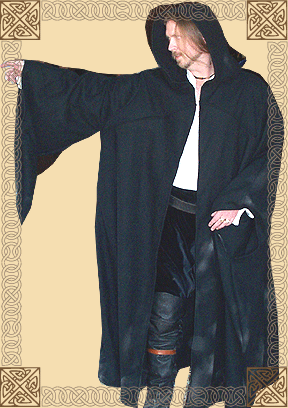
Cloaks
changed from squares or triangles of wool, clasped with chained
pins or brooches at one shoulder, to knee-length over-the-head
enveloping garments. Amongst other luxurious accents, cloaks
were embellished with embroidery; gold, silver, or copper
wire trim sewn on; narrow coloured step weaving; and fur edging.
If actual fur was out of the question, the skilled Anglo-Saxon
housewife could actually create a looping weave on her loom
in apparent imitation of fur or fleece. Hoods, when seen,
were both individual items or integral to the cloak.
Early
in the Anglo-Saxon period, women wore their hair loose, plaited,
or caught in snood-like nets. Simple caps are also found.
By the 7th century veil-like head coverings become more popular,
and Kentish grave finds suggest brooches and pins may have
held these in place. Curling tongs exist, so some hair must
have been meant to be seen. As the period progresses women
show less and less of their crowning glory - possibly as a
result of the growing grip of Christianity and St. Paul’s
injunction that women keep their heads covered - so that by
the 11th century a headdress nearly envelopes the head and
neck in a nun-like wimple.
Woman’s
footwear changed least. Flat-soled ankle height leather boots,
fastened with a side over-flap with toggles or laces, were
standard. As leather tanning was well advanced, perhaps these
boots were dyed various colours, or worked with carved or
die-struck ornamentation for the wealthy.
What
the Well-Dressed Thegn was Wearing
As
always, less change is evident in men’s clothing over
the period than in women’s. A linen loincloth or short
brief-style breeches may have been worn under closely fitting
legging-like trousers of wool. A leather or woven belt held
the trousers at the waist, and leather strips were sometimes
wrapped around the calves to protect them. Well-to-do men
wore a linen under tunic with fitted sleeves under their outer
tunic of wool.
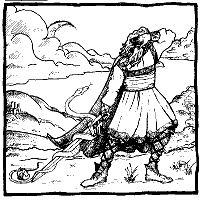
In
the 5th and 6th centuries the tunic was short, thigh length,
and usually sleeveless, and cinched with a leather belt. Though
the 7th to 11th centuries tunics generally sported sleeves,
and a wide variety of sleeve lengths are depicted, including
those with long full sleeves, long tight sleeves, and contrasting
coloured cuffs along with contrasting collar bands. Tunics
are still above the knee but beginning to lengthen, and illustrations
from the 10th and 11th centuries show some very long, calf-length
tunics, most especially for kings.
Men
generally enjoyed the freedom of going bare-headed except
in cold weather when furred caps were worn. By the end of
the period a tall pointed cap, with the point often shown
as bent over, became fashionable. Short ankle boots with toggle
or laced fastenings were the norm, and appear to be nearly
identical in both men and women, though the men’s sometimes
have more pointed toes. Monastic records note "wool night
shoes"; these may have been warm slippers of felted wool
worn to protect monk's feet from the cold. Certainly there
may have been a secular corollary. Costly gloves, richly embroidered,
are mentioned by several men in their wills.
Men
typically wore their hair rather long, past the ear or shoulder-
length; a close-cropped head was the sign of a slave (or a
Norman). Anglo-Saxon men must have greatly valued their long
hair, for the following law occurs in the Law Code of King
Ælfred (b. 849-d. 899 CE):
If
someone restrains a free man...(and) as a humiliation...he
shaves (his head) like a priest's, without binding him, let
him pay compensation of thirty shillings. If he shaves off
his beard, let him pay compensation of twenty shillings. If
he ties him up and then shaves his head like a priest's, let
him pay compensation of sixty shillings. (extracted from Law
35, translated by Bill Griffiths)
If you consider that the penalty for cutting off a man's leg
(Law 72) or arm (Law 66) was eighty shillings, you will understand
that the steep sixty shilling fine for a forced haircut (hair
being a resource which after all will grow back) was exacted
as it struck at the notion of a man's dignity.
Cottars, Borders, Slaves, Children
Simple
agricultural folk wore simple utilitarian clothing which allowed
them mobility for the arduous tasks of household and farm.
It
would perhaps be a mistake to think that the average farm
worker was awash in dull brown, gray, or even undyed wool.
As most dyestuff was readily available for the picking, there
is no reason to suppose the milk-maid’s gown was any
less brightly-coloured than her mistress’s everyday
dress. It would certainly be of courser-grade stuff, lack
costly (and time-consuming) embellishments such as elaborate
embroidery, but her cloak might just as well be lined with
soft domestic squirrel snared by her father as her mistress’
was with arctic fox traded by merchants.
Slaves
wore whatever it pleased their owner to provide for them;
in Summer some must have been essentially naked save for the
briefest of loin cloths or shifts.
Newborns
were closely swaddled and diapered in surprisingly modern
appearing cloths (the square of cloth that forms the folded
diaper must surely be the most unchanging article of human
apparel, being thousands of years old, and the classic nappy
still has not been totally supplanted by its machine-shaped
disposable substitute). Children were dressed in miniature,
simplified versions of adult clothing.
Silk
and Leather
The
very rich - kings, king’s kin, archbishops - might cherish
one or more garments of silk. Imported from the East at fabulous
cost, silk’s ability to take and hold the most brilliant
of colours, coupled with its natural shimmer, must have particularly
delighted our Anglo-Saxon ancestors. Silk was worked into
gowns for women, tunics for men, and most especially cloaks
or hooded mantles for both sexes. Certainly such a garment
would only be worn in fair weather, perhaps as part of ceremonial
display, but since timber halls could be cold and draughty
places, these sumptuous garments could be enjoyed indoors
as well.
Silk
is the type of clothing most often mentioned in Anglo-Saxon
bequests, for its intrinsic worth and the rich treatment it
often received (gold and silver embroidery, gemstones sewn
upon it) gave it singular value in the deceased’s estate.
Leather
was of course of immense utility for shoes and belts, but
also was used for jerkins, cloaks, and leg-wrappings that
served rather like protective greaves. Tanners could create
a variety of charcoal, black, and brown colours during the
tanning process (which inevitably employed disagreeable raw
materials including all sorts of human and animal excrement)
and finished leather could be additionally painted or stained
with mineral pigments. Leather workers used pokers and irons
to etch and burn decorative patterns, as well as dies with
stamped designs.
Where
to See Fashion
Manuscript
painting, either in facsimile (or for the fortunate, in the
original) is the prime source for examples of Anglo-Saxon
clothing, although remember that you are generally observing
vignettes from the lives of the aristocracy. Books such as
The Anglo-Saxons edited by James Campbell ( Penguin 1982)
contain many photos of manuscript personages, along with carvings
depicting clothed figures. Dorothy Whitelock’s Beginnings
Of English Society (a source I never tire of citing) speaks
to wills and bequests, and Dress in Anglo-Saxon England by
Gale Owen-Crocker is an essential source. An earlier book
by the same scholar, then writing as Gale R. Owen, Rites and
Religions of the Anglo-Saxons (recently reissued by Barnes
& Noble) contains detailed information on clothing and
jewellery in grave finds.
Finally,
Anglo-Saxon style clothing is simple to design and sew, even
for the novice. Stitching by hand lends great authenticity
to seaming (you are absolved from using a bone needle) and
is wonderfully calming. Purchase lightweight pure wool in
colours pleasing to you and use wool thread of narrow gauge
(needlepoint tapestry yarn, reduced to a single ply, is a
good choice). If this seems a bother, use silk rather than
polyester or cotton-blend thread. The decoration of the gown
can be as elaborate as you have time for, and can be accumulatively
embellished bit by bit over the years. Historic recreation
societies always boast skilled seamstresses amongst their
numbers, should you get bogged down and need advice, stylistic
or technical. Esther Stouten, a very talented costumer, has
created a stunning example of a ninth century gown. Attractive
brooches and other jewellery bits are readily available from
Past Times, and Museum Replicas has short boots based on the
York Coppergate model and other interesting leather goods.
Wear your creation at Yule celebrations and other festive
occasions and be proud.
|
|
